Traditional form builders (try our AI alternative) treat conditional logic like programming.
You're forced to think in terms of "if-then-else" statements, boolean operators, and nested conditions.
Consider this common scenario:
What you want: "Show the follow-up questions if someone is interested in our premium service, but skip the pricing section if they're a student or nonprofit."
What traditional builders force you to do:
- Create Rule 1: Field "Service Interest" equals "Premium" → Show "Follow-up Questions"
- Create Rule 2: Field "Organization Type" equals "Student" OR "Nonprofit" → Hide "Pricing Section"
- Debug why Rule 2 isn't working (spoiler: it needs to be Field "Organization Type" not equals "For-profit")
- Test every possible combination
- Discover edge cases you missed
- Start over
This approach has fundamental flaws:
Experience AI-Powered Form Creation
Generate professional forms in seconds with natural language AI
Start Free →Users must translate natural business logic into artificial rule structures.
Your brain works in stories and scenarios, not boolean algebra.
Every dropdown, every operator selection, every nested condition is an opportunity for mistakes.
One wrong selection breaks the entire logic chain.
Try returning to a complex rule set six months later.
What seemed logical then looks like hieroglyphics now.
Traditional builders can only handle what their interface allows.
Want to express nuanced business logic? Good luck finding the right combination of dropdowns.

Photo by Shubham Dhage on Unsplash
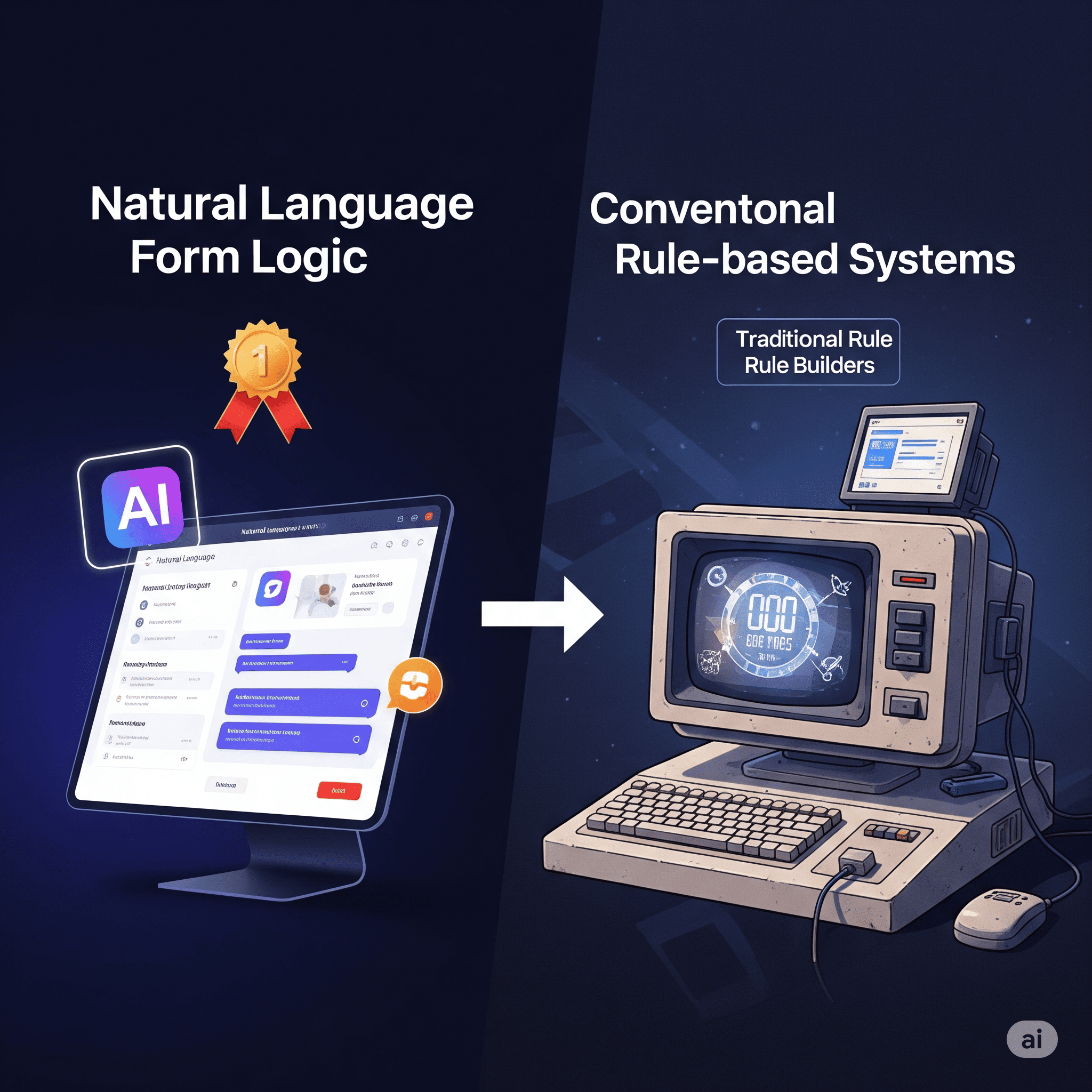
Natural language form logic flips the script. Instead of translating your intent into a rule builder's language, you simply describe what you want:
"Show follow-up questions if someone is interested in premium service, but skip pricing for students and nonprofits."
That's it. No dropdowns, no operators, no debugging nested conditions. The AI understands your intent and makes it happen.
Let's compare traditional vs natural language approaches for common form scenarios:
Traditional Rule Builder:
IF field_budget equals "Under $10k"
AND field_timeline equals "ASAP"
THEN show field_alternatives
AND hide field_premium_options
ELSE IF field_budget equals "Over $50k"
THEN show field_premium_options
AND show field_consultation_booking
Natural Language:
"Show budget-friendly alternatives for urgent projects under $10k.
For high-budget clients over $50k, show premium options and consultation booking."
Traditional Rule Builder:
IF field_attendee_type equals "VIP"
THEN show field_special_requests
AND show field_parking_valet
ELSE IF field_attendee_type equals "General"
AND field_dietary_restrictions not_equals "None"
THEN show field_meal_options
Natural Language:
"VIP attendees get special requests and valet parking options.
General attendees with dietary restrictions see meal choices."
Traditional Rule Builder:
IF field_experience_years greater_than 5
AND field_leadership_role equals "Yes"
THEN show field_management_questions
AND show field_salary_expectations_senior
ELSE show field_growth_interests
AND show field_salary_expectations_junior
Natural Language:
"Experienced leaders with 5+ years see management questions and senior salary fields.
Others get growth interest questions and junior salary options."
The natural language versions are immediately understandable to anyone on your team, from marketing to HR to executives.
You already know how to express complex logic in English. No new syntax to learn, no interface to master.
As AI improves, your natural language descriptions get more powerful automatically. No need to rebuild rules in new interfaces.
Anyone can read and understand natural language logic. No more "rule builder experts" gatekeeping form updates.
Six months later, "Show pricing for interested prospects but skip for students" is still crystal clear.
Natural language can express nuanced scenarios that rule builders struggle with: "Show upgrade options unless they're a nonprofit or mentioned budget concerns."

Photo by Possessed Photography on Unsplash
Modern AI can parse natural language with remarkable accuracy. When you write "Show pricing for enterprise clients but skip for nonprofits," the AI understands:
This isn't magic—it's the same language understanding that powers chatbots and voice assistants, applied to form logic.
Natural language form builders (try our AI alternative) provide preview modes where you can test your logic before going live. Most misunderstandings are caught immediately.
Natural language doesn't mean imprecise. You can be as specific as needed: "Show Section A if dropdown B contains exactly 'Enterprise' and checkbox C is checked."
If your logic is too complex for natural language, it's probably too complex for your users too. Natural language forces clarity.

Photo by Melinda Gimpel on Unsplash
Transitioning from traditional rule builders to natural language is straightforward:
1. Start with new forms: Build your next form with natural language logic
2. Migrate gradually: Convert your most complex rule sets first (you'll see the biggest benefit)
3. Train your team: Share examples of natural language patterns that work well
4. Test thoroughly: Use preview modes to verify logic before publishing
While your competitors struggle with rule builder interfaces, you'll be shipping forms faster, maintaining them easier, and onboarding team members without training overhead.
Natural language form logic isn't just easier—it's a fundamental shift toward more intuitive, maintainable, and powerful form building.
The future of form building is conversational, not computational.
Instead of learning another interface, use the language you already know.
Your forms should work the way you think, not the way databases think.
While your competitors wrestle with rule builders, you'll be deploying intelligent forms that actually make sense.
Explore our natural language solutions and see how conversational logic transforms form building.
---
Ready to experience natural language form logic? Start your free trial and build your first intelligent form in minutes, not hours.
About Formzil: We're revolutionizing form building with AI-powered natural language logic. No more rule builders, no more technical barriers—just describe what you want, and watch your forms come to life.
---
- Traditional rule builders force unnatural thinking patterns
- Natural language matches how you already think about form logic
- AI-powered interpretation handles complex scenarios automatically
- Teams collaborate better when everyone understands the logic
- Migration from rule builders is straightforward and immediately beneficial
Ready to Transform Your Workflow?
Use AI to create better forms faster
No credit card required • 3 forms free, forever