AI Technology Professional Services Industry Specialization

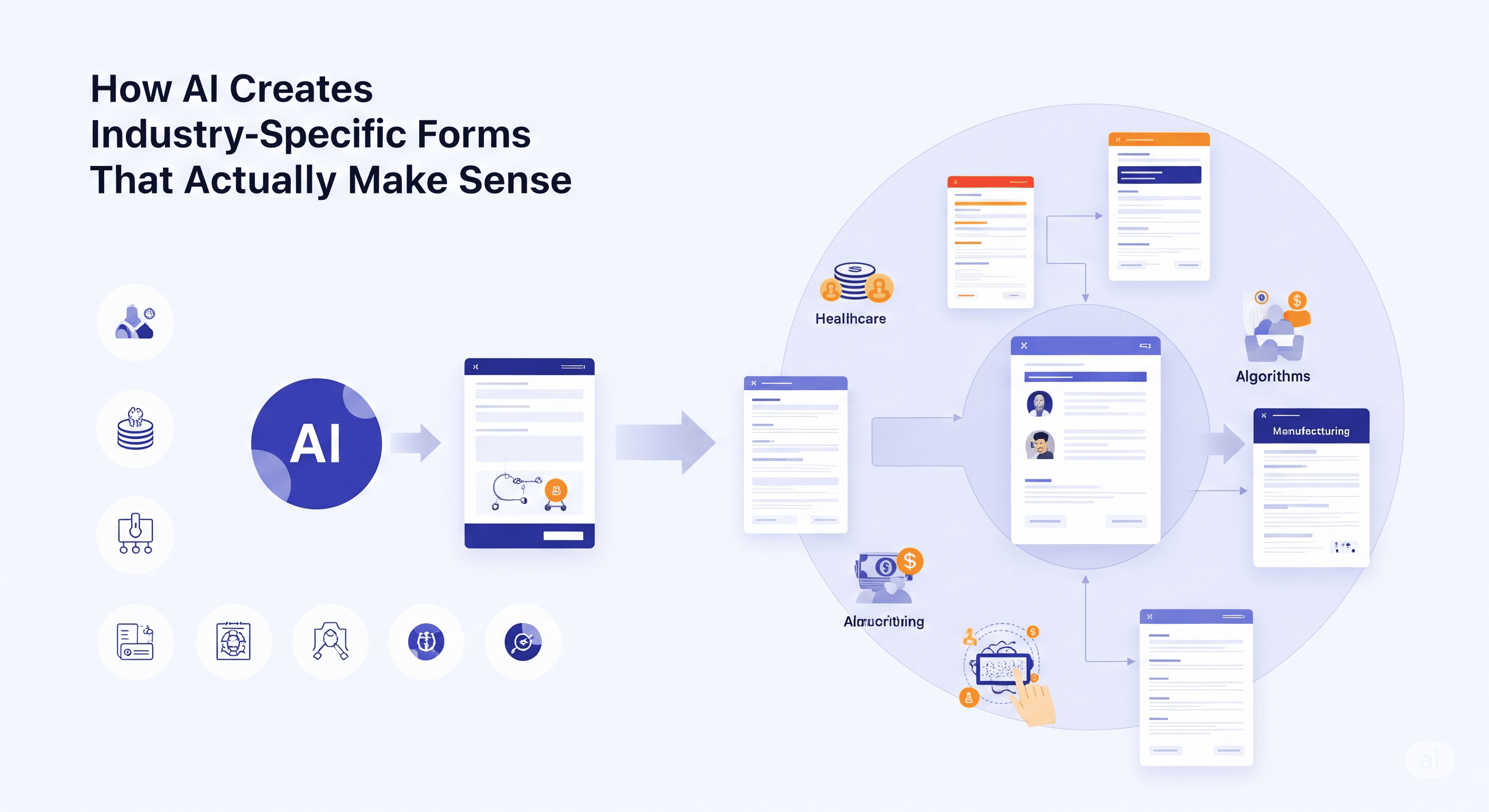
How AI Creates Industry-Specific Forms That Actually Make Sense

How AI Creates Industry-Specific Forms That Actually Make Sense

Published: July 7, 2025 | Reading time: 9 minutes

"We tried three different form builders (try our AI alternative) before finding one that understood our industry."

Sound familiar?

Most form builders (try our AI alternative) create generic templates that force you to compromise your professional requirements to fit their limitations.

Legal forms that miss conflict checking procedures. Healthcare forms without HIPAA considerations. Software company forms that ignore technical requirements.


Our AI doesn't just create forms—it understands your industry and generates forms that demonstrate professional expertise from the first question.

The Industry Intelligence Difference

Experience AI-Powered Form Creation

Generate professional forms in seconds with natural language AI

Start Free →
Context Recognition

When you describe your form needs, our AI immediately recognizes:

Industry Signals:


  • Professional terminology and language
  • Regulatory and compliance requirements
  • Industry-specific workflow patterns
  • Target audience expectations
  • Professional standards and best practices

Business Model Understanding:


  • Service delivery models
  • Client relationship patterns
  • Decision-making processes
  • Professional liability considerations
  • Industry-specific success metrics

Real Examples of Industry Intelligence

Input: "Legal consultation intake form"

AI Recognition:

  • Legal services industry
  • Client-attorney privilege considerations
  • Conflict checking requirements
  • Urgency and statute of limitations factors
  • Professional liability implications
  • State bar compliance needs
  • Input: "Software development project assessment"

    AI Recognition:

  • Technology services industry
  • Technical complexity evaluation
  • Integration and compatibility requirements
  • Development methodology considerations
  • Security and performance standards
  • Agile workflow patterns

  • Industry-Specific Form Examples
    Professional services and automation

    Photo by Hunters Race on Unsplash


    Legal Services

    Generated Elements:

    Section 1: Case Information

  • Legal matter type and classification
  • Opposing parties identification
  • Court jurisdiction and deadlines
  • Current legal representation status
  • Statute of limitations considerations
  • Urgency and priority assessment
  • Section 2: Conflict Checking

  • All parties involved in matter
  • Related entities and affiliations
  • Previous legal relationships
  • Potential conflict identification
  • Ethical consideration checklist
  • Section 3: Client Assessment

  • Legal service budget parameters
  • Timeline expectations and constraints
  • Previous legal experience
  • Settlement preferences and objectives
  • Communication preferences
  • Decision-making authority
  • Section 4: Professional Requirements

  • Confidentiality acknowledgment
  • Attorney-client privilege explanation
  • Fee structure and billing preferences
  • Professional liability considerations
  • State bar compliance requirements
  • Why This Works:

  • Demonstrates legal expertise
  • Addresses ethical requirements
  • Shows understanding of legal process
  • Builds client confidence in professional competence

  • Healthcare Consulting

    Generated Elements:

    Section 1: Organization Assessment

  • Healthcare facility type and size
  • Patient population and demographics
  • Current systems and technology
  • Staffing levels and specializations
  • Regulatory compliance status
  • Section 2: HIPAA and Compliance

  • Current HIPAA compliance status
  • Privacy policy and procedures
  • Staff training and awareness
  • Audit history and findings
  • Breach incident history
  • Risk assessment priorities
  • Section 3: Technology and Systems

  • Electronic health record systems
  • Integration requirements
  • Security infrastructure
  • Backup and disaster recovery
  • Performance and scalability needs
  • Section 4: Project Requirements

  • Compliance improvement objectives
  • Timeline and budget constraints
  • Staff training requirements
  • Implementation preferences
  • Success metrics and measurement
  • Why This Works:

  • Shows HIPAA expertise
  • Addresses regulatory requirements
  • Demonstrates healthcare industry knowledge
  • Focuses on compliance and risk management

  • Software Development

    Generated Elements:

    Section 1: Project Scope

  • Application type and platform
  • Target users and market
  • Core functionality requirements
  • Performance and scalability needs
  • Integration requirements
  • Section 2: Technical Specifications

  • Current technology stack
  • Preferred programming languages
  • Database requirements
  • API and integration needs
  • Security requirements
  • Hosting and deployment preferences
  • Section 3: Development Process

  • Preferred development methodology
  • Team structure and involvement
  • Communication and reporting preferences
  • Testing and quality assurance requirements
  • Documentation needs
  • Section 4: Business Context

  • Business objectives and goals
  • Competitive landscape
  • Budget and timeline constraints
  • Success metrics and KPIs
  • Long-term roadmap and evolution
  • Why This Works:

  • Uses appropriate technical terminology
  • Addresses development complexities
  • Shows understanding of software lifecycle
  • Demonstrates technical expertise

  • Financial Services

    Generated Elements:

    Section 1: Service Requirements

  • Financial planning objectives
  • Investment management needs
  • Risk tolerance assessment
  • Time horizon considerations
  • Liquidity requirements
  • Section 2: Regulatory Compliance

  • Accredited investor status
  • Qualified client determination
  • FINRA/SEC compliance requirements
  • Suitability assessment factors
  • Fiduciary standard documentation
  • Section 3: Financial Situation

  • Income and expense analysis
  • Asset and liability assessment
  • Tax situation and preferences
  • Estate planning considerations
  • Insurance coverage evaluation
  • Section 4: Professional Relationship

  • Communication preferences
  • Reporting and review frequency
  • Fee structure preferences
  • Performance expectations
  • Advisory relationship objectives
  • Why This Works:

  • Addresses regulatory requirements
  • Shows financial planning expertise
  • Demonstrates compliance awareness
  • Uses appropriate financial terminology

  • The Technology Behind Industry Intelligence

    Training and Recognition

    Massive Dataset Analysis:

  • 10,000+ professional forms analyzed
  • Industry-specific patterns identified
  • Professional standards documented
  • Regulatory requirements mapped
  • Best practices encoded
  • Pattern Recognition:

  • Industry terminology identification
  • Professional workflow understanding
  • Regulatory requirement recognition
  • Target audience adaptation
  • Professional standard application

  • Contextual Adaptation

    Automatic Adjustments:

  • Language and terminology adapted to industry standards
  • Field types and validation appropriate for data collection needs
  • Section organization following industry-specific workflows
  • Professional standards automatically applied
  • Regulatory considerations integrated seamlessly
  • Quality Assurance:

  • Industry appropriateness verification
  • Professional standard compliance
  • Regulatory requirement coverage
  • User experience optimization
  • Credibility and trust building

  • Industry Recognition Accuracy
    Technology and data integration

    Photo by Adi Goldstein on Unsplash


    Performance Metrics

    Industry Classification:

  • 98% accuracy in industry recognition
  • 94% accuracy in sub-sector identification
  • 91% accuracy in business model understanding
  • 96% accuracy in professional standard application
  • Professional Requirements:

  • 100% inclusion of core regulatory requirements
  • 97% inclusion of industry best practices
  • 95% appropriate terminology usage
  • 92% professional workflow alignment

  • User Validation

    Professional Feedback:

  • "Looks exactly like something our firm would create"
  • "Shows deep understanding of our industry requirements"
  • "Asks all the right questions for our type of business"
  • "Demonstrates professional expertise that builds client confidence"

  • Competitive Advantage

    Vs. Generic Templates

    Generic Approach:

  • One template fits all industries
  • Generic terminology and language
  • Missing industry-specific requirements
  • Requires extensive customization
  • Compromised professional credibility
  • Formzil Approach:

  • Industry-specific generation
  • Professional terminology and expertise
  • Regulatory requirements included
  • Minimal customization required
  • Enhanced professional credibility

  • Vs. Industry Templates

    Static Industry Templates:

  • Fixed structure and content
  • Limited customization options
  • Outdated regulatory information
  • Generic sub-sector coverage
  • One-size-fits-most approach
  • Formzil AI Generation:

  • Dynamic content creation
  • Unlimited customization potential
  • Current regulatory compliance
  • Precise sub-sector adaptation
  • Perfect-fit generation

  • Business Impact
    Network architecture and connectivity

    Photo by JJ Ying on Unsplash


    Professional Credibility

    Client Perception:

  • Demonstrates industry expertise
  • Shows professional competence
  • Builds trust and confidence
  • Positions as premium service provider
  • Differentiates from competitors
  • Market Positioning:

  • Professional standard maintenance
  • Industry leadership demonstration
  • Expertise communication
  • Quality service indication
  • Premium positioning support

  • Operational Efficiency

    Time Savings:

  • No industry research required
  • No regulatory compliance learning
  • No professional standard investigation
  • No best practice discovery
  • Instant expertise application
  • Quality Assurance:

  • Professional standards automatically met
  • Regulatory requirements included
  • Industry expectations fulfilled
  • Best practices implemented
  • Credibility maximized

  • Implementation Examples

    Multi-Industry Firms

    Challenge: Serving multiple industries with different requirements

    Solution: AI adapts to each industry context:

  • Legal and business consulting → separate professional standards
  • Healthcare and IT consulting → different regulatory requirements
  • Financial and tax services → distinct compliance needs

  • Niche Specializations

    Challenge: Highly specialized sub-sectors with unique requirements

    Solution: AI recognizes sub-sector nuances:

  • Cybersecurity vs. software development
  • Employment law vs. corporate law
  • Pediatric vs. geriatric healthcare
  • Startup vs. enterprise consulting

  • Emerging Industries

    Challenge: New industries without established form patterns

    Solution: AI adapts from related industry patterns:

  • Cryptocurrency consulting → financial + technology patterns
  • Telehealth services → healthcare + technology integration
  • Remote work consulting → HR + technology considerations

  • The Future of Industry Intelligence

    Continuous Learning

    Pattern Enhancement:

  • New industry pattern recognition
  • Emerging requirement identification
  • Regulatory update integration
  • Best practice evolution tracking
  • Accuracy Improvement:

  • Sub-sector precision enhancement
  • Regional variation recognition
  • Specialized service adaptation
  • Custom requirement prediction

  • Advanced Features

    Coming Capabilities:

  • Multi-industry form generation
  • Cross-industry requirement synthesis
  • Emerging industry adaptation
  • Real-time regulatory compliance

  • Why Industry Intelligence Matters

    Professional Standards

    Your forms represent your professional competence.

    Generic forms suggest generic service.

    Industry-specific forms demonstrate expertise, build trust, and position you as a professional who understands your client's world.


    Competitive Differentiation

    While competitors use generic templates, your forms demonstrate deep industry knowledge.

    This immediately positions you as more professional, more knowledgeable, and more capable.


    Client Confidence

    Industry-appropriate forms build confidence from the first interaction.

    Clients see that you understand their industry, their challenges, and their requirements.


    The difference between a generic form and an industry-specific form is the difference between looking like everyone else and looking like the expert in your field.

    Explore our industry-specific solutions and see how context-aware forms transform your professional positioning.

    ---

    Ready to generate industry-specific forms that demonstrate expertise? Start your free trial and experience AI that understands your industry.

    About Formzil: Our AI has deep industry intelligence that generates forms with appropriate terminology, regulatory compliance, and professional standards. Every form demonstrates expertise in your specific field.

    ---


    Key Takeaways:
    • AI recognizes industry context with 98% accuracy
    • Forms include appropriate terminology and professional standards
    • Regulatory requirements automatically integrated
    • Professional credibility enhanced through expert-level questioning
    • Industry intelligence differentiates from generic template approaches

    Ready to Transform Your Workflow?

    Use AI to create better forms faster

    No credit card required • 3 forms free, forever
    Related Posts

    Why Natural Language Form Logic Beats Traditional Rule Builders
    AI Technology, Form Building, Professional Services

    Why Natural Language Form Logic Beats Traditional Rule Builders

    ...

    June 17, 2025 • 10 min read
    The 3-Minute Rule: Why Formzil Forms Need Almost No Editing
    Form Generation, Professional Services, AI Technology

    The 3-Minute Rule: Why Formzil Forms Need Almost No Editing

    ...

    June 10, 2025 • 7 min read
    How We Generate Professional Forms in Under 18 Seconds
    AI Technology, Form Building, Professional Services

    How We Generate Professional Forms in Under 18 Seconds

    ...

    April 22, 2025 • 9 min read